Expertise / Data, CDP & MarTech
Data must be usable, not merely collected.
CRM, personalisation and marketing automation depend on the information beneath the communication layer.
I work at the intersection of marketing, customer data and technology: from business needs and customer journeys to data requirements, integrations, segmentation, activation, decisioning, reporting and governance.
My role is often to translate between marketing and the technical teams: What data do we have? What is missing? Where should it come from? Which systems need it? And which marketing decision should it enable?
- Customer Data
- CDP
- MarTech
- Integrations
- Decisioning
- BI
- Marketing Operations
More data is not necessarily better data
I do not usually start with: “Which data points can we track?” I start with: “Which decision do we need to be able to make?”
For example:
- Who should receive the communication?
- Where is the customer in the lifecycle?
- What has the customer bought or shown interest in?
- How engaged is the customer?
- Which product, content or offer is most relevant?
- Which channel can the customer be contacted through?
- Which marketing activity has the customer already been exposed to?
- Which action should trigger the next journey?
- How do we measure the impact?
Then we can define the data, systems and integrations that are needed. My working logic is typically:
Data is not the end product. It is the input to a better decision.
Which data does marketing actually need?
I have defined CRM and CDP data requirements based on specific marketing and customer journey needs.
How do we identify and connect the customer across the relevant systems?
Where is the person in their relationship with the company?
What has the customer bought, when and how often?
Which products, pages, events or features has the customer interacted with?
How does the customer respond to previous communication?
How recently, how often and with what value does the customer purchase?
Where does the customer or lead come from?
Which forms of tracking and communication has the customer agreed to?
Is geography relevant to the product, the offer or the communication?
Can the customer actually receive the chosen channel?
How is customer behaviour connected to the relevant product, event or content?
The specific data need always depends on the business model. I therefore prefer to define data from use cases and customer journeys rather than building large datasets without a clear purpose.
From fragmented signals to usable customer insight
I have worked with CDP and customer data challenges since 2022. For me, the value of a CDP is not the platform itself. The value lies in whether the company gets better at collecting, understanding and activating relevant customer signals.
Profile, engagement, lifecycle stage and permissions.
Website visits, product interest, downloads or other digital behaviour.
Purchases, frequency and history.
Products, categories, events and metadata.
Marketing source, campaign and lead source.
Once the data is connected, it can be used for, among other things:
- Segmentation
- RFM
- Personalisation
- Recommendation logic
- Lead scoring
- Lifecycle journeys
- Suppression
- Paid audiences
- Next-best-offer
- Reporting
That is why I see a CDP as part of an overall CRM and marketing architecture, not as an isolated technology project.
Data should end in an action
What makes customer data interesting is what the company can do differently because of it.
Who?
- RFM
- engagement
- purchase history
- lifecycle stage
- lead score
- customer value
- location
- behaviour
What?
- product
- event
- content
- message
- offer
- recommendation
When?
- sign-up
- purchase
- browse behaviour
- booking
- deadline
- inactivity
- change in lifecycle stage
Should we communicate?
- consent
- engagement
- suppression
- channel availability
- contact frequency
- competing journeys
It is the connection between data → decisioning → activation that makes customer data valuable in practice.
Marketing needs must be translated into technical requirements
I often work between Marketing, BI, Product and Development. My role may be to define:
- which data points marketing needs
- which systems the data comes from
- where it will be used
- which time intervals are relevant
- how the data should be filtered and segmented
- which trigger or decisioning logic the data should support
- how the impact should be measured afterwards
I do not necessarily code the integration myself. My strength lies in defining the business and marketing need, scoping the solution and working with the teams that implement it technically. That makes it possible to bridge marketing logic and technical implementation without blurring responsibilities.
From thousands of events to a marketing decision
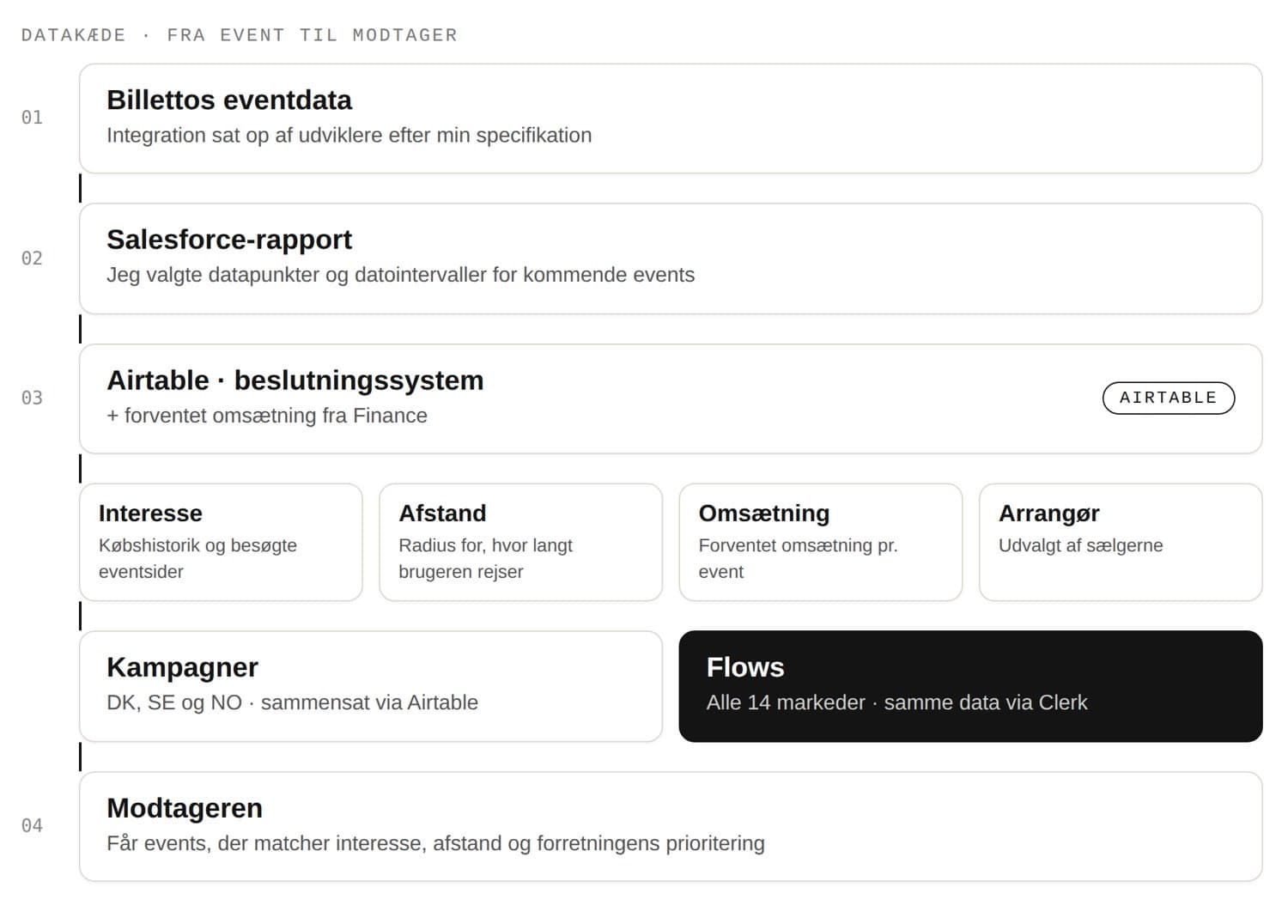
At Billetto, the challenge was not a lack of content. With more than 20,000 events, there was almost always something to promote. The question was: Which events are relevant enough that we should communicate them to each customer?
I defined the data need, scoped the integration for Development and configured a Salesforce report with relevant event data and time intervals. The data was then operationalised in an Airtable-based decision system. The signals included:
Previous purchases and event pages visited.
The customer’s location and a relevant travel radius.
Forecast supplied by Finance.
Sales could highlight organisers of particular strategic importance.
This gave Marketing a more structured basis for prioritising campaigns by both customer relevance and business value. At the same time, automated journeys could activate customer and event data through Clerk and Klaviyo, among others.
Measurement should make the next decision better
I work with data both for activation and for evaluation. This includes:
- KPI definition
- Data sources
- Reporting requirements
- Dashboard structure
- Visualisation needs
- CRM performance
- Email performance
- Paid performance
- Lifecycle performance
I have worked with BI on data foundations and Power BI, and with dashboards that combined marketing data from several sources. A dashboard has limited value, though, if it only documents the past. It should help answer: What is happening? Why? And what should we do differently?
Complex setups must be operable by an organisation
As CRM, data and MarTech setups grow, operations and governance become part of the solution itself. That is why I also work with:
- Flow mapping
- Documentation
- SOPs
- QA
- Naming conventions
- Change logs
- Dashboards
- Operational workflows
- Campaign planning
- Stakeholder alignment
- Project systems
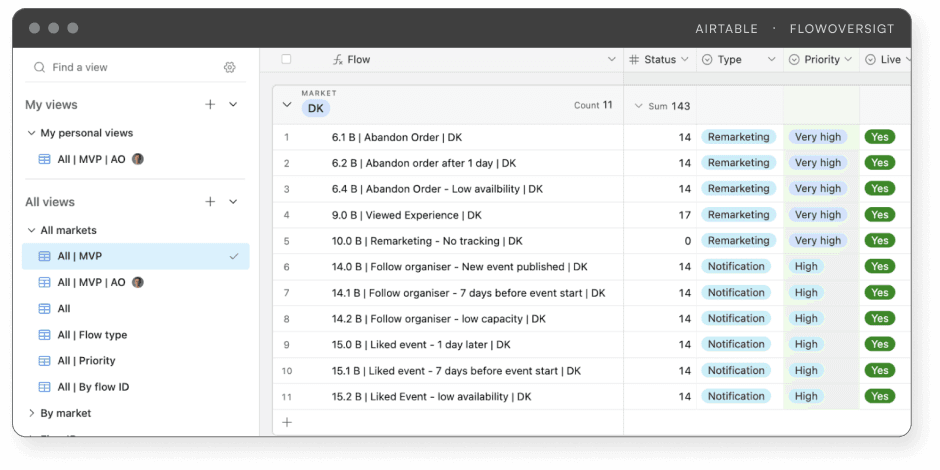
At Billetto, for example, the marketing automation setup was mapped in Airtable so that flows, triggers, segments, emails and changes could be understood without first opening each flow in Klaviyo. That made the system easier to understand, maintain, update, document and hand over.
Marketing operations is not administration around marketing. It is part of what makes complex marketing and data systems scalable and operable.
Available data is not necessarily usable data
Customer data should not only exist technically. There also need to be clear rules for how it may be used. I have worked with, among other things:
- Consent flows
- Opt-in and opt-out
- Communication permissions
- Suppression
- Tracking consent
- Cookie consent
- Data retention
- Hashing
- Anonymisation
- Tracking audits
- Cookiebot
- Script firing based on consent status
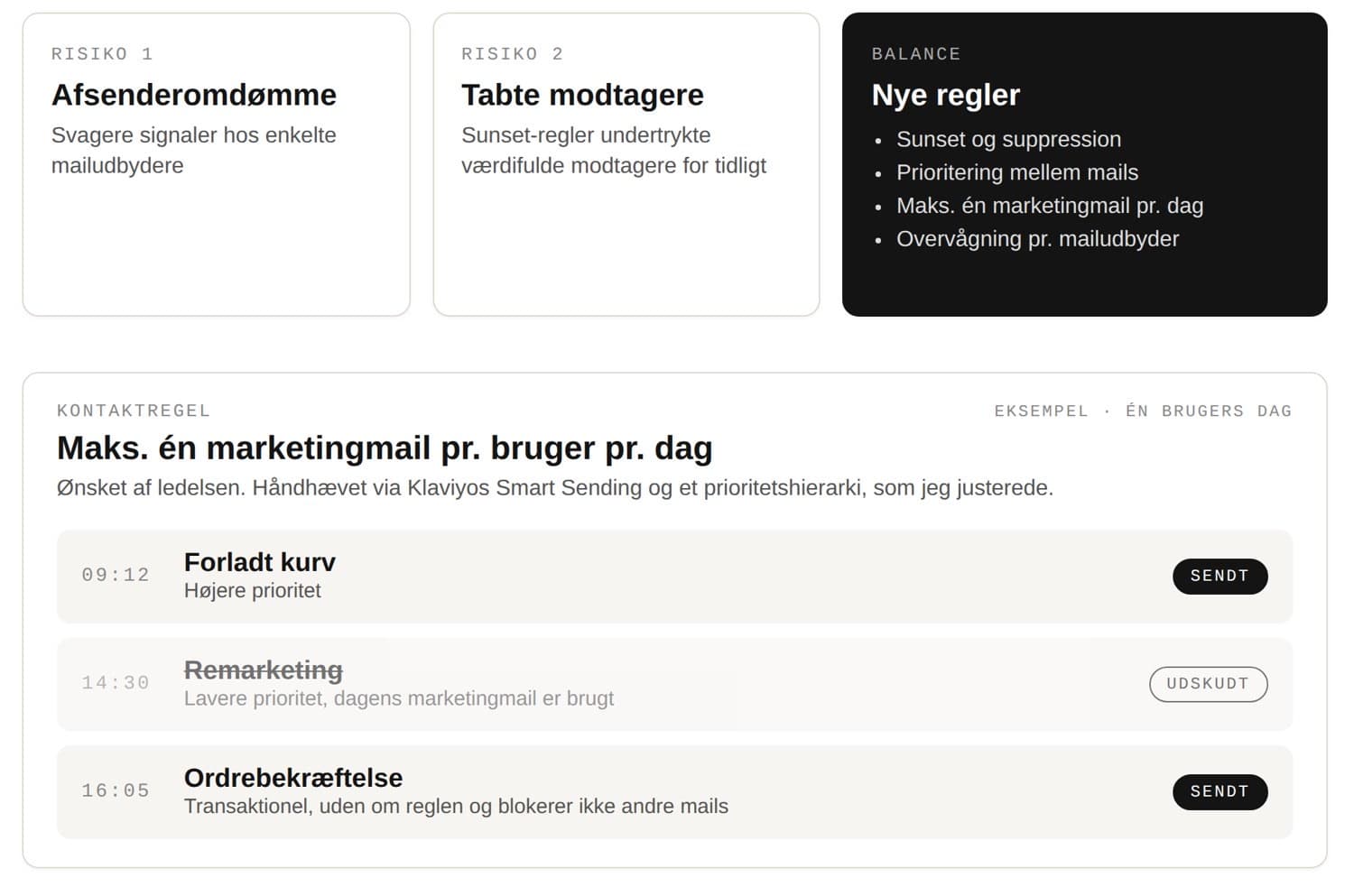
I have also worked with situations where data existed in a system but could not simply be activated for marketing. Governance is therefore about both compliance and creating a data foundation that marketing can actually trust.
The platform must fit the architecture
I have advised on the selection of CRM, marketing automation and CDP platforms based on, among other things:
- Data model
- Integration needs
- Ecommerce data
- Product feeds
- Sales workflows
- Sales handoff
- Reporting
- Automation capabilities
- Scalability
- Implementation complexity
- Builder and design needs
- CDP needs
That is why I am not tied to any one platform. The right stack depends on the company’s:
- Customer journey
- Data
- Organisation
- Processes
- Integration needs
Hands-on experience across the stack
CRM & marketing automation
- Klaviyo
- HubSpot
- ActiveCampaign
- Salesforce
- Adobe Campaign
Customer data & personalisation
- Segment
- Clerk
Marketing operations & integration
- Airtable
- Zapier
BI & measurement
- Power BI
- Looker Studio
- GA4
- Google Tag Manager
Consent
- Cookiebot
I have been a Klaviyo Partner since 2024. I do not position myself as a specialist in any one platform. The strength lies in the underlying logic:
When data, marketing and systems need to work better together
Defining which data marketing actually needs.
Turning customer signals into segmentation, journeys and decisions.
Translating marketing needs into requirements for BI, Product and Development.
Assessing how platforms, data and workflows should fit together.
Using behaviour, customer value and other signals for more relevant marketing.
Defining measurement and the reporting that should support decisions.
Documentation, QA, governance and processes that make the setup operable.
Assessing CRM, MA and CDP platforms against real requirements rather than feature lists.
Data is the foundation. The customer journey is the purpose.
Data, CDP and MarTech are closely connected to my work in CRM & Lifecycle.
On the CRM side, the question is typically: Who should be contacted, when and with what?
On the data side, the question is: Which data, systems and processes need to exist for us to make that decision?
That combination is where I work best.
Looking for someone with this mix of CRM, growth and marketing experience? Let’s talk.
If marketing, customer data and systems need to work better together, you are welcome to get in touch.
Senior roles · Interim · Selected projects