Skip to content
Andreas OttesenANDREASOTTESEN.COM

Expertise / CRM & lifecycle

CRM & Lifecycle

Customer journey first. Platform second.

I work with CRM, lifecycle and marketing automation from first contact through onboarding, engagement, retention, reactivation and win-back.

The starting point is the customer journey and the business objective: What behaviour can we observe? What data do we have? Who should we contact, and who should we leave alone? What is the relevant next action, and how do we know whether communication actually creates value? From there, I turn the strategy into segmentation, decisioning, triggers, automations, contact policy, communication, tests and operational processes.

10+years of marketing experience
2017CRM & marketing automation since
B2B + B2Cacross industries
View CRM cases →
CRM as a decision system

CRM is more than flows and emails

A CRM setup only creates real value when customer data is used to make better decisions about who to contact, when, with what and through which channel.

That is why I work across the whole chain:

Business objectivecustomer journeydatasegmentationdecisioningtriggerchannelcommunicationtestmeasurementoptimisation
A setup without structure

An existing setup that has grown without structure.

A strategy from scratch

A lifecycle strategy that needs to be built from the ground up.

Untapped potential

An organisation with a CRM platform and data that is not yet getting enough value from them.

My work spans strategy and architecture through to hands-on implementation, QA, documentation and ongoing optimisation.

Lifecycle & customer journeys

Communication should follow the customer’s situation, not just the marketing calendar

I design and optimise lifecycle journeys based on the customer’s behaviour, relationship and next relevant action.

01

Acquisition & lead nurture

  • Sign-up and welcome journeys
  • Lead nurturing
  • Lead scoring
  • Lead → MQL → SQL
  • Booking and enquiry journeys
  • Behavioural triggers
02

Conversion

  • Browse abandonment
  • Abandoned cart
  • Product and content interest
  • Recommendation logic
  • Personalised messages
  • Deadline- and event-based communication
03

Onboarding & engagement

  • Onboarding
  • Lifecycle-stage communication
  • Activation
  • Login- and app-based triggers
  • Behaviour-based communication
  • Engagement journeys
04

Retention

  • Churn risk
  • Churn prevention
  • Reactivation
  • Win-back
  • Repeat purchase
  • Engagement-based suppression
  • Sunset logic

Lifecycle is therefore not one standard flow. It is a system of customer states, signals and decisions that need to fit together.

Models, segmentation & decisioning

From customer data to decisions

I use different models and decision logic depending on the business model, the data available and the customer journey.

The goal is not to implement a model for its own sake. It should help prioritise customers, communication and marketing effort better.

01

RFM

Recency · Frequency · Monetary value

RFM can be used to understand differences between customers based on how recently they have purchased, how often they purchase and the value they represent. I have used RFM as the basis for:

  • Customer segmentation
  • Prioritising communication
  • Assessing engagement and customer value
  • Audience building
  • Lifecycle decisioning
  • Activation in other marketing channels
02

Customer value & CLV-based prioritisation

Not every customer or lead should be treated the same

Customer value and CLV-related signals can be used to prioritise marketing effort and understand where the greatest potential lies for retention, repeat purchases or further investment.

I use customer value as an input to decisions, not as an isolated KPI.

03

Engagement scoring

Opens, clicks, website activity, downloads, purchases and more

Behaviour can be used to assess engagement. Among other things, it can influence:

  • Segmentation
  • Contact frequency
  • Nurture
  • Suppression
  • Reactivation
  • Prioritisation between flows
04

Lead scoring & MQL/SQL

Lead → MQL → SQL

In B2B, I work with lead scoring and progression. Scoring can be based on behavioural signals such as:

  • Email engagement
  • Downloads
  • Website behaviour
  • Lifecycle stage
  • Other relevant buying signals

Here CRM has to work alongside Sales, so that timing, handoff, nurture and suppression support the sales process rather than compete with it.

05

Lifecycle stages

The customer’s current relationship is worth more than static segmentation

Leadnew customeractivehigh valueat riskinactivereactivated

The specific stages depend on the business model. The point is to let the customer’s current situation shape the next treatment.

06

Recommendation logic & next-best-offer

Interest · history · location · customer value

When product, behavioural and customer data are available, they can be used to choose more relevant content, products or offers. I have worked with recommendation logic and next-best-offer thinking.

07

Treatment and uplift thinking

Who can marketing actually influence?

The most valuable audience is not necessarily the customer most likely to buy. I use treatment and uplift thinking as a decision principle for audiences and impact, but I do not position myself as a specialist in advanced statistical uplift modelling.

Contact policy

More communication is not automatically better communication

As the number of campaigns and automated journeys grows, the question is not only what can be sent, but also what should take priority.

I work with:

  • Contact frequency
  • Smart Sending
  • Suppression
  • Sunset logic
  • Engagement-based rules
  • Competing flows
  • Flow prioritisation
  • Marketing vs. transactional communication
  • Channel eligibility

For example, a customer may qualify for several flows at the same time. There need to be rules for which communication wins, what can wait and when the customer should not be contacted at all.

An effective lifecycle strategy is as much about choosing not to communicate as it is about automating more.

Retention & customer engagement

Retention starts before the customer is on the way out

Retention is not just a win-back flow sent after six months of inactivity. I work with the whole journey:

Onboardingengagementcustomer valuerisk signalsretentionreactivationwin-back

This typically requires a combination of:

  • Lifecycle stages
  • Purchase history
  • Engagement
  • Product behaviour
  • Time since last activity
  • Customer value
  • Channel and consent status
  • Relevant triggers

The goal is to identify where the relationship can be strengthened, and where communication can genuinely change customer behaviour.

Channels

The right channel depends on the situation

I have worked with lifecycle communication and audiences across:

  • Email
  • SMS
  • Push
  • Web personalisation
  • Paid audiences

I do not see the channel as the starting point. A push notification only makes sense if the customer has the app. An email only makes sense if the customer both can and should be contacted. And in some situations, a paid audience can be more relevant than yet another CRM message.

Channel choice should follow the customer’s situation, permissions and the desired action.

Data & marketing operations

The best flows are worthless if the data foundation does not work

Lifecycle and marketing automation depend on the data that enters the system. That is why I also work with the underlying CRM and marketing operations structure:

  • Data requirements
  • Customer IDs and event data
  • Purchase history
  • Behavioural events
  • Lifecycle stage
  • Consent
  • Geography
  • Channel eligibility
  • Integration needs
  • Dashboards and KPI definition
  • QA
  • Documentation
  • Flow mapping
  • Naming conventions
  • Change logs
  • Governance
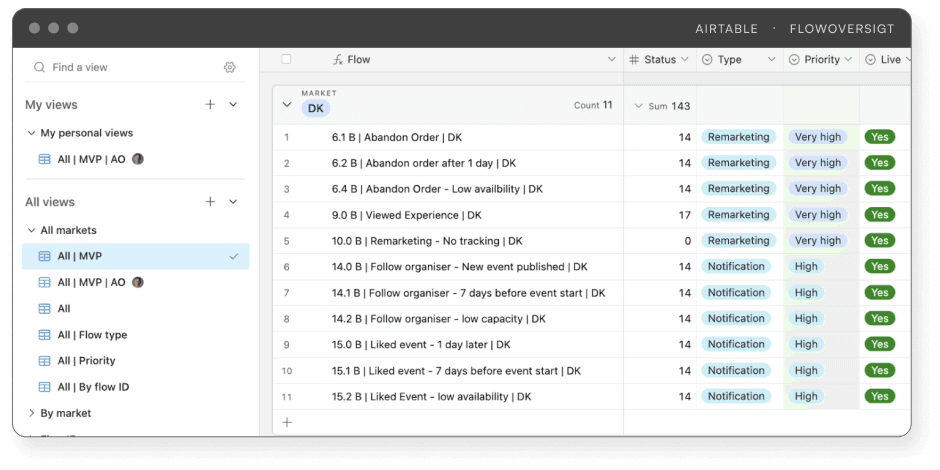
Flow mapping in Airtable

I can translate marketing needs into requirements that BI, Product and Development can take forward.

This does not necessarily mean that I write the integration code myself. My role may be to define the need, the data logic and the intended use, and to work with the technical specialists on the implementation.

Marketing automation

From strategy to a setup that can actually be operated

A complex automation setup should not only work on the day it launches. It must also be possible to:

  • understand
  • test
  • maintain
  • document
  • hand over
  • change without unintended consequences

That is why I work both with the automations themselves and with the operational structure around them. This can include:

  • Flow architecture
  • Triggers
  • Segments
  • Filters
  • Splits
  • Content
  • QA
  • Naming
  • Documentation
  • Governance
  • Testing
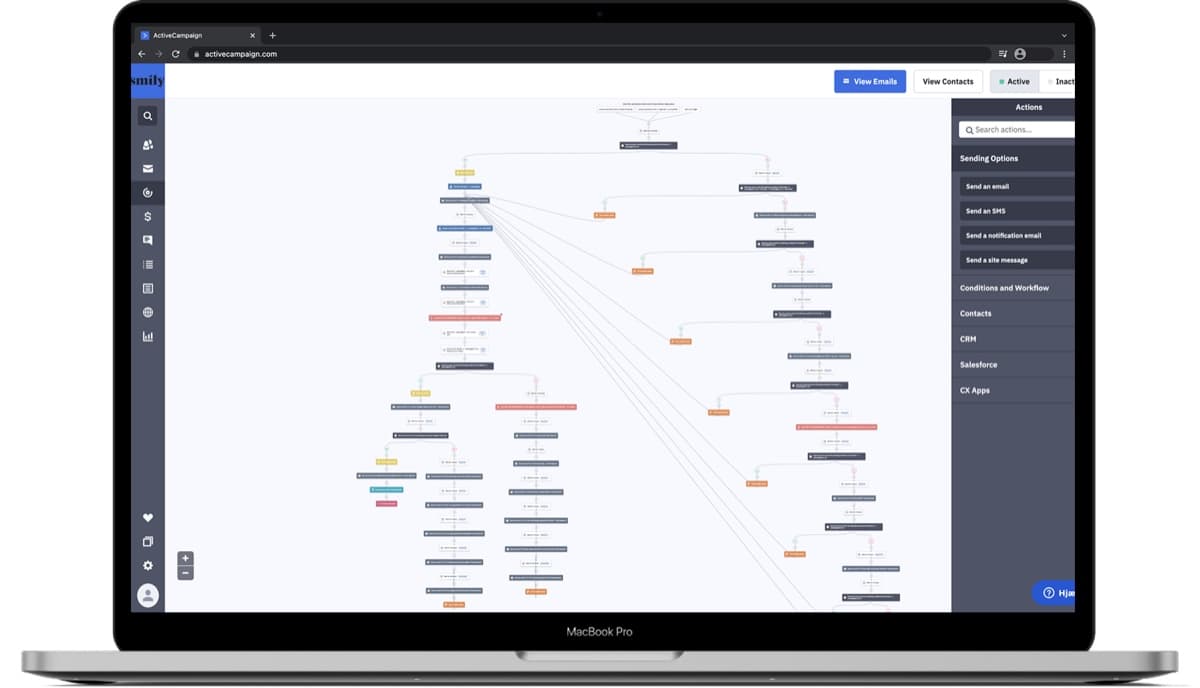
Automation flow

This is especially important in larger setups with many flows, markets, stakeholders and data sources.

Testing & optimisation

A flow is not finished just because it is live

I work continuously with hypotheses and tests of, among other things:

  • Subject lines
  • Copy
  • Design
  • Flow structure
  • Campaign variants
  • Segments
  • Timing
  • Contact frequency

Tests should be used to make decisions, not just to produce a dashboard. If the data shows that another solution works better, the setup should change.

Platforms

Platform-capable, not platform-dependent

I have hands-on experience with CRM, marketing automation, customer data and related systems, including:

CRM & marketing automation

  • Klaviyo
  • HubSpot
  • ActiveCampaign
  • Salesforce
  • Adobe Campaign

Customer data & personalisation

  • Segment
  • Clerk

Marketing operations & integration

  • Airtable
  • Zapier

Data & measurement

  • Power BI
  • Looker Studio
  • GA4
  • Google Tag Manager

I am a Klaviyo Partner with substantial hands-on experience of the platform. At the same time, I do not position myself as a specialist in any single piece of software. The platform changes from company to company; the underlying CRM logic changes far less.

Selected proof

CRM & lifecycle in practice

Billetto
CRM · Lifecycle · International

Billetto: lifecycle at international scale

CRM and email communication to 1M+ recipients across 14 markets. The work covered lifecycle architecture, RFM, behavioural segmentation, recommendation logic, contact policy, governance and marketing operations. 392 lifecycle instances were mapped, 150+ automations rebuilt, and the setup included 462 emails.

+44%email CTR
+56%email revenue YoY
up to +90%CTR in A/B tests
View the Billetto case →
SMILY
Journey design · Automation

SMILY: journeys driven by customer actions

For the launch, I designed lifecycle communication around the customer’s actual progression through the journey. Communication changed based on sign-up, booking, online test, behaviour and the customer’s treatment stage.

6automations
100+emails, built in ActiveCampaign
View the SMILY case →
Dirks
Acquisition · CRM · Customer value

Dirks: acquisition and CRM as one system

Rather than optimising only for a direct purchase, lead generation was connected to automated nurturing, newsletters, remarketing and ecommerce communication. The case shows the relationship between acquisition economics, CRM, customer value and lifecycle.

View the Dirks case →
B2B CRM

When CRM also has to work with Sales

I have worked with B2B customer journeys and lead management where CRM does not stop at marketing. The experience covers lead scoring, behavioural signals, lead → MQL → SQL, nurture, qualification, Sales handoff, timing, suppression and CRM/Sales alignment.

I have worked with this logic in both Adobe Campaign and later HubSpot setups. The specific scoring models from individual projects are confidential, but the approach is the same: use behaviour and data to prioritise the right leads and coordinate marketing communication with Sales.

Where I typically add value

When CRM needs to move from activity to system

I am particularly relevant when an organisation needs to:

  • Establish or rethink its lifecycle strategy
  • Audit an existing CRM or automation setup
  • Bring structure to many flows and automations
  • Improve onboarding, retention or reactivation
  • Develop segmentation and RFM
  • Establish lead scoring and B2B nurture
  • Improve contact policy and suppression
  • Migrate or implement a CRM/MA platform
  • Define CRM or CDP data requirements
  • Turn customer data into decisioning and personalisation
  • Document the CRM setup and make it more scalable
  • Improve collaboration between Marketing, Sales, BI, Product and Development

Let’s talk about CRM, lifecycle and marketing automation

I work both strategically and hands-on to turn customer journeys, data and marketing technology into CRM setups that can be implemented, operated and improved over time.

Senior roles · Interim · Selected projects

Contactao@andreasottesen.com+45 27 42 68 12LinkedIn: Andreas Ottesen
ANDREASOTTESEN.COM© 2026 Andreas Ottesen